




The third Payment Services Directive (PSD3) represents a major development in the European regulatory landscape for payments. Introduced by the European Commission in June 2023, this directive aims to modernise payment services, strengthen security, protect consumers and encourage innovation in the financial sector.
Among the significant new features of PSD3 is the Verification of Payee scheme (VoP; “Vérification du Bénéficiaire” in French), designed to improve the accuracy and security of financial transactions.

Background and objectives of PSD3
PSD3 follows on from the previous directives, PSD1 and PSD2, seeking to create an integrated payments market within the European Union.
While PSD2, adopted in 2015, strengthened consumer protection, PSD3 aims to go further by tackling emerging challenges, with the goal of adapting the regulatory framework to technological developments and new fraud threats.
The main objectives of PSD3 are:
- Strengthening payment security: by introducing additional measures to protect consumers against fraud.
- Improving consumer protection: by guaranteeing broader rights in the event of fraud and improving the transparency of payment services.
- Stimulating innovation: by promoting fair competition and encouraging the development of new financial services.
- Harmonising regulations: by ensuring that the rules are applied uniformly across all EU Member States.
The Verification of Payee (VoP) scheme
The major innovation introduced by PSD3 is the Verification of Payee (VoP) scheme.
It aims to check that the payee’s name matches the IBAN before a credit transfer is executed. The main objective is to reduce errors and fraud linked to misdirected payments or identity theft.
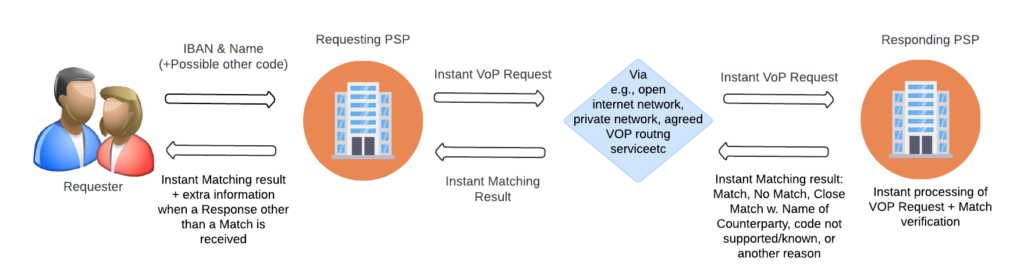
How VoP works
The Verification of Payee process works as follows:
- Initiating the verification: When a payer wishes to make a credit transfer, their payment service provider (PSP) sends a verification request to the payee’s PSP.
- Checking the information: The payee’s PSP checks whether the name and IBAN provided match the information on record.
- Responding to the request: The payee’s PSP sends back a response indicating whether the information matches, does not match, or is a partial match.
- Informing the payer: The payer’s PSP informs the payer of the outcome of the verification, allowing them to confirm or cancel the transfer based on the information received.
This process aims to provide additional security by ensuring that funds are sent to the right recipient, thereby reducing the risk of fraud and errors.
Implementation and timeline
The VoP scheme is due to be implemented over 18 months:
- 📅March 2024: Publication of the first version of the VoP scheme rulebook by the European Payments Council (EPC).
- 📅9 October 2025: Deadline for all European PSPs providing SEPA payments to offer the Verification of Payee service to their customers.
It is essential that PSPs start preparing now to implement this scheme in order to meet the regulatory deadlines and avoid potential penalties.
Implications for businesses
The introduction of the VoP scheme has several implications for treasury departments:
- Checking how your banks will operate: PSPs/banks will need to define the types of verification to be requested and ensure smooth implementation.
- VoP option: Treasury departments will be able to opt for this new service as of 9 October: what will the consequences be for those that do not opt for it?
- Training and awareness: It will be crucial to explain to teams, and to warn suppliers about, the potential impacts of VoP if the option is taken.
- Third-party master data: It is important to review companies’ supplier databases, and particularly employee data, to avoid numerous rejections if the option is taken.
- Handling rejections : How will companies deal with the many rejections when using electronically transmitted payment files? Will entire files be rejected, or only the transfer concerned?
Expected benefits
The introduction of PSD3 and the VoP scheme should bring several advantages:
- Reduced fraud: By ensuring that funds are sent to the right recipient, VoP will help reduce cases of fraud linked to input errors or identity theft.
- Greater consumer confidence: Users will have more confidence in payment services, knowing that additional measures are in place to protect their transactions.
- Increased efficiency: Standardising verification processes will facilitate cross-border transactions and shorten processing times.
- Stronger innovation: By creating a safer and more transparent environment, PSD3 will encourage the development of new financial services and stimulate competition.
Challenges ahead
Despite the potential benefits, implementing PSD3 and the VoP scheme presents many challenges:
- Technical complexity: Integrating VoP into existing infrastructure will require significant investment by PSPs and updates to IT systems.
- Compliance costs: Financial institutions will have to bear the costs of adapting their processes and training their staff, as this service must be free of charge for their customers.
- Harmonisation across countries: Implementing PSD3 will require coordination between Member States to ensure uniform application and avoid regulatory divergence.
In summary
PSD3 and the VoP scheme represent a major step forward for payment security and transparency in Europe. By strengthening consumer protection and reducing the risk of fraud, these new regulations should foster a safer and more efficient payment environment. However, implementing them will require significant efforts from payment service providers, regulators and users. In the long run, this development should contribute to a more competitive, innovative and harmonised payments market within the European Union.
👆 Need support? Contact our teams of specialists at Altermès, who will be able to guide you!
💸 Feel free to discover our cash services support offering
📃You can also read our other articles by clicking here !