





You have started your business on your own, with limited resources, and you run it in your own name. In this case, the most suitable legal status is the sole proprietorship (EI, entreprise individuelle).

Which tax, social security and VAT regime for my sole proprietorship?
The auto-entreprise disappeared several years ago and survives today only as a loose turn of phrase. What exists now is the sole proprietorship (EI) under the micro-enterprise regime. This means that your legal status is the EI and your regime is the micro-enterprise.
Understanding the distinction is fundamental, because there is another tax regime (income tax) and social security regime (URSSAF, the French social security collection agency) under which an EI can operate: the simplified real regime (régime réel simplifié). As you will see, it is all a question of thresholds. And what about VAT? We will cover this point in the conclusion, and there too it is all a question of thresholds.
The micro-enterprise regime
In short, the micro-enterprise means few administrative formalities and greater simplicity for your returns and regulatory obligations (even more so if you opt for the flat-rate withholding payment, versement libératoire, a scenario we leave aside here). It is divided into two parts: tax and social security.
The micro-tax regime
The rules governing the micro-tax regime (régime micro-fiscal) determine your profit and, in fine, the amount of your income tax.
To be taxed under this regime, your annual turnover over a full calendar year (01/01 – 31/12) must not exceed the following ceilings:
- €188,700 for the sale of goods, items, supplies, etc.;
- €77,700 for the provision of services;
- €188,700, including a maximum turnover of €77,700 for the provision of services, in the case of a mixed activity;
Once your annual turnover has been established, the tax authorities determine your profit by applying a flat-rate allowance. This profit then becomes your taxable income, on which your income tax is calculated.
If you exceed the above thresholds on a lasting basis, you must leave the micro-entrepreneur regime and switch to the simplified real regime. This will then be the time to ask yourself: should I remain an EI or set up another type of company? We have devoted an article to this subject.
Micro-tax regime vs simplified real regime
A sole proprietorship under the simplified real regime determines its own profit by keeping accounts of its income and expenses. Every year, it must draw up a simplified balance sheet and income statement and submit them to the tax authorities.
The micro-social regime
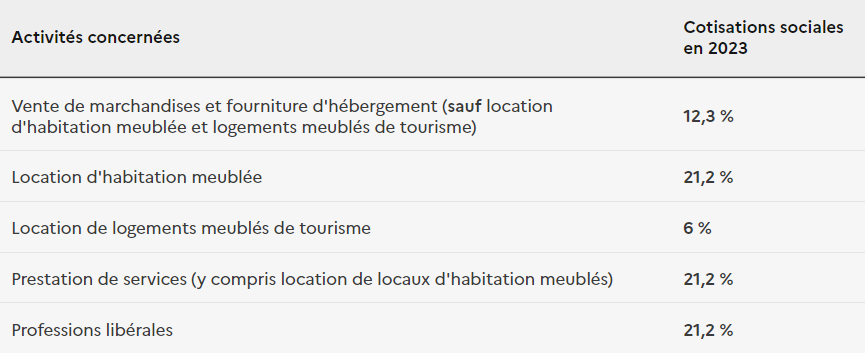
Micro-entrepreneurs pay social security contributions (health insurance, family allowances, CSG – the general social contribution, etc.). Their amount is determined by applying a flat rate to your turnover actually received. There is no minimum: €0 of turnover = €0 of contributions to pay.
Current rates:
Micro-social regime vs simplified real regime
If you exceed the same turnover thresholds mentioned above on a lasting basis and switch to the simplified real regime, your business’s taxable profit then becomes the basis for your URSSAF contributions. The most common situation corresponds to a rate of 44% (it may vary depending on your business’s location, its activity, etc.). If there is no turnover, minimum contributions are payable.
Now that you clearly understand that the EI is a legal status and the micro-enterprise a regime under which your EI can operate, we can conclude with VAT, and here too it is all a question of regime and threshold.
The VAT regime
In principle, in the world of the sole trader, VAT does not exist. This regime is called the “basic VAT exemption” (franchise en base de TVA). Your invoicing including VAT is equal to your invoicing excluding VAT. For your customer, whether a business or an individual, it makes no difference at all.
All this holds true as long as you do not exceed the turnover thresholds:
- €36,800 per year for the provision of services
- €91,900 per year for the sale of goods, items, supplies, etc.
If you exceed these thresholds, you switch to the simplified real VAT regime and become liable for VAT on a mandatory basis. From then on, you charge VAT on top of the price of your service. Micro-entrepreneurs sometimes find themselves having to charge VAT to their customers in the middle or at the end of the year; this is a well-known situation. As a micro-entrepreneur, you must therefore be prepared for this eventuality.
📞 If you have a question or a project, or would like support from Altermès, feel free to get in touch with our experts!
👆 Find out more about our wealth management expertise services!